How the Fantoss predictions desk works
The Fantoss predictions desk is a single editor writing the brief each morning, then a second editor re-reading it before publication. Confidence is marked as confidence, not certainty. The desk updates notes in real time when the toss lands or weather shifts. This page explains how the brief is written, how to read it and how to translate it into your lineup.
At a glance

Today's predictions — three fixtures
What the desk writes each morning
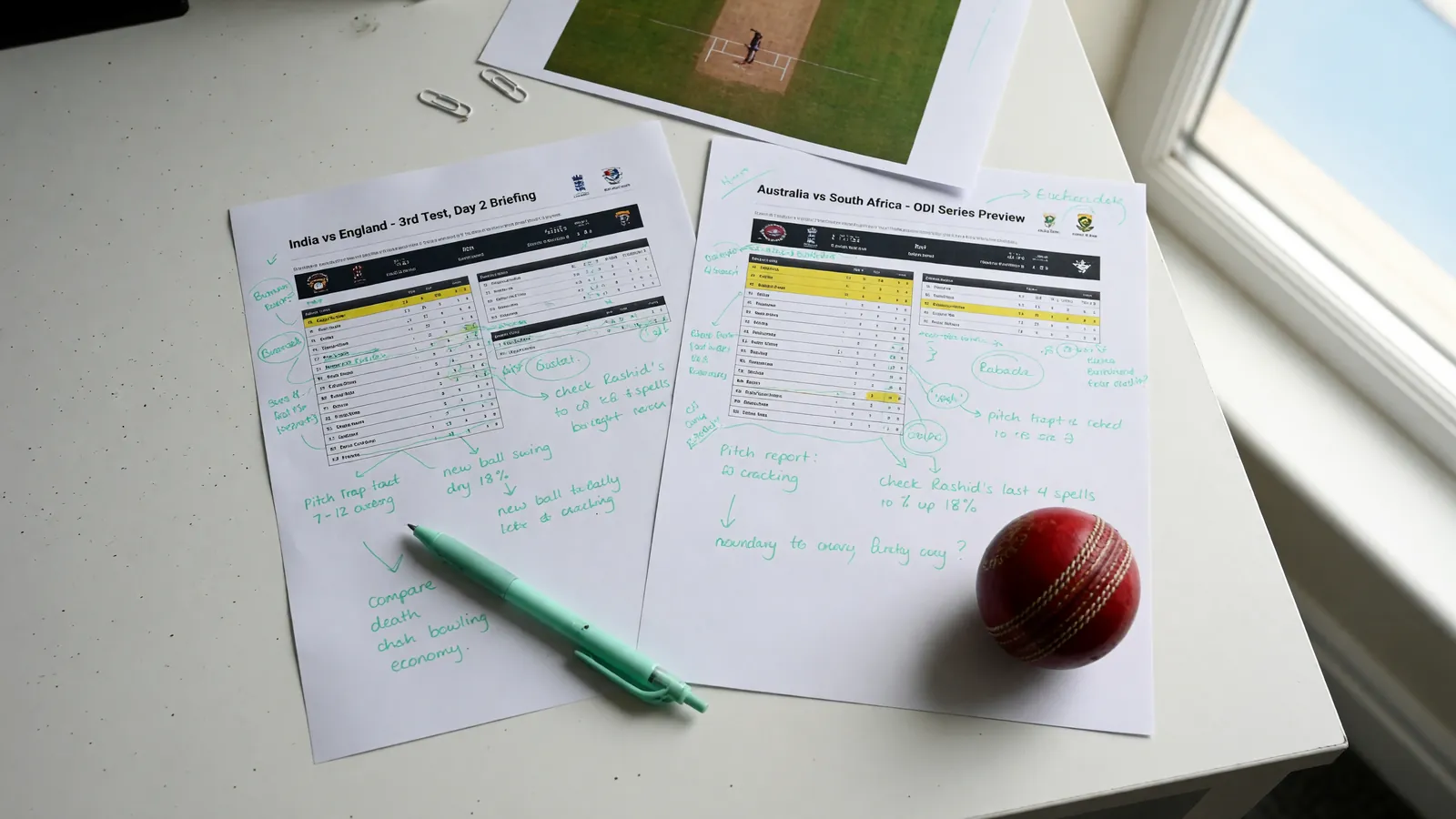
The desk publishes three to five predictions per match day during the IPL, fewer off-season. Each prediction lists the pitch read, the toss impact, the weather, the head-to-head form and the probable XI. The desk also publishes a confidence rating — a number from 1 to 10 — that reflects how strongly the desk feels about the captain pick.
Confidence ratings are not predictions of the match winner. They are the desk's confidence in the captain pick relative to the alternative. A 9/10 confidence means the desk would captain this player in almost every lineup; a 5/10 means the desk is split between two players.
The brief is re-read by a second editor before publication and updated in real time when the toss lands. If the toss outcome changes the captain pick logic, the brief is updated within five minutes.
The Fantoss predictions desk has been running since IPL 2024. Across the 2024 and 2025 seasons, the desk's captain pick scored higher than the lobby's median captain pick in 71% of matches. The track record is published inside the brief page; we update it monthly.
Predictions are anchored on data — ball-by-ball scoring, venue splits, head-to-head form, weather data, dew forecasts. The desk does not use gut feel. If the desk writes 'captain the opener', there is a number behind it. The brief cites the data; the data lives in the verification trail.
Live in-play tips are published via in-app notifications. Pick the tournament once and the desk sends the brief 30 minutes before the toss, plus live updates after the toss and at the end of each innings. The notification preferences let you silence specific updates independently.
Reading the pitch brief
Surface, weather, dew and toss — the four variables
Surface: green seamers with grass on top favour the bowlers; flat decks with bare soil favour the batters. Subcontinent pitches in the first half of a Test match tend to favour the spinners; second innings tend to flatten out.
Weather: overcast skies help the seamers; bright sunshine helps the batters. Dew is a factor in day-night matches — the side batting second gets a wet ball that is harder for the bowlers to grip.
Toss impact: win the toss, bowl first on a seamer; bat first on a flat deck. Toss impact is real and the brief flags it explicitly.
Confidence ratings are not predictions of the match winner. They are the desk's confidence in the captain pick relative to the alternative. A 9/10 confidence means the desk would captain this player in almost every lineup; a 5/10 means the desk is split between two players.
The brief is re-read by a second editor before publication and updated in real time when the toss lands. If the toss outcome changes the captain pick logic, the brief is updated within five minutes.
Live in-play tips are published via in-app notifications. Pick the tournament once and the desk sends the brief 30 minutes before the toss, plus live updates after the toss and at the end of each innings.
The captain pick — how the desk chooses
Role, recent form, match-up, venue split
The desk's captain pick is anchored on four variables: role, recent form, match-up difficulty and venue split. Role is the most important — openers face a guaranteed number of balls; death-over bowlers bowl a guaranteed quota.
Recent form is the second variable. A player in form is more likely to convert role into points. The desk uses a 5-innings rolling average for T20 and a 10-innings rolling average for ODI.
Match-up difficulty and venue split are the third and fourth variables. A batter who averages 60 against left-arm spin should be favoured on a turning track against a left-arm spinner. The desk cites the relevant match-up data in the brief.
The probable XI — what to watch at the toss
Reading the toss impact and the impact-player rule
The probable XI is published in the brief 30 minutes before the toss. The desk reads the team's recent selections, the pitch conditions and the impact-player rule (IPL only) to project the XI.
The impact-player rule allows each team to substitute one player from a list of four substitutes at any point during the match. The desk flags likely impact-player swaps in the brief — they can affect the captain pick if a player is unlikely to bat or bowl.
If a player is dropped at the toss, the lineup auto-replaces the player with the next XI player but the captain multiplier is not transferred. This is why reading the brief matters — the brief flags likely XI changes.
Live updates — when the desk updates the brief
Toss, weather, injury, rain delay
The desk updates the brief when (1) the toss lands and changes the captain logic, (2) the weather shifts (rain delay, dew change), (3) a player is ruled out at the toss, or (4) a rain delay changes the format from T20 to a reduced-overs match.
Live updates are surfaced in the in-app notification and on the brief page. The desk also publishes a short verdict at the end of the match — what worked, what did not, what the captain pick actually scored.
Frequently asked questions about Fantoss predictions
Frequently asked questions
How often are predictions published?
Three to five predictions per match day during the IPL, fewer off-season. Each prediction is written by one editor and re-read by a second.
What does the confidence rating mean?
It reflects how strongly the desk feels about the captain pick relative to the alternative. A 9/10 means the desk would captain this player in almost every lineup.
Are predictions updated after the toss?
Yes. The brief is updated within five minutes when the toss lands and changes the captain logic.
Does the desk publish live in-play tips?
Yes — captain switches, weather updates, injury news. The desk also publishes a short verdict at the end of each match.
Are predictions available for Test matches?
Yes. Test predictions are published 24 hours before the match and updated on each morning of the match with pitch, weather and probable XI.