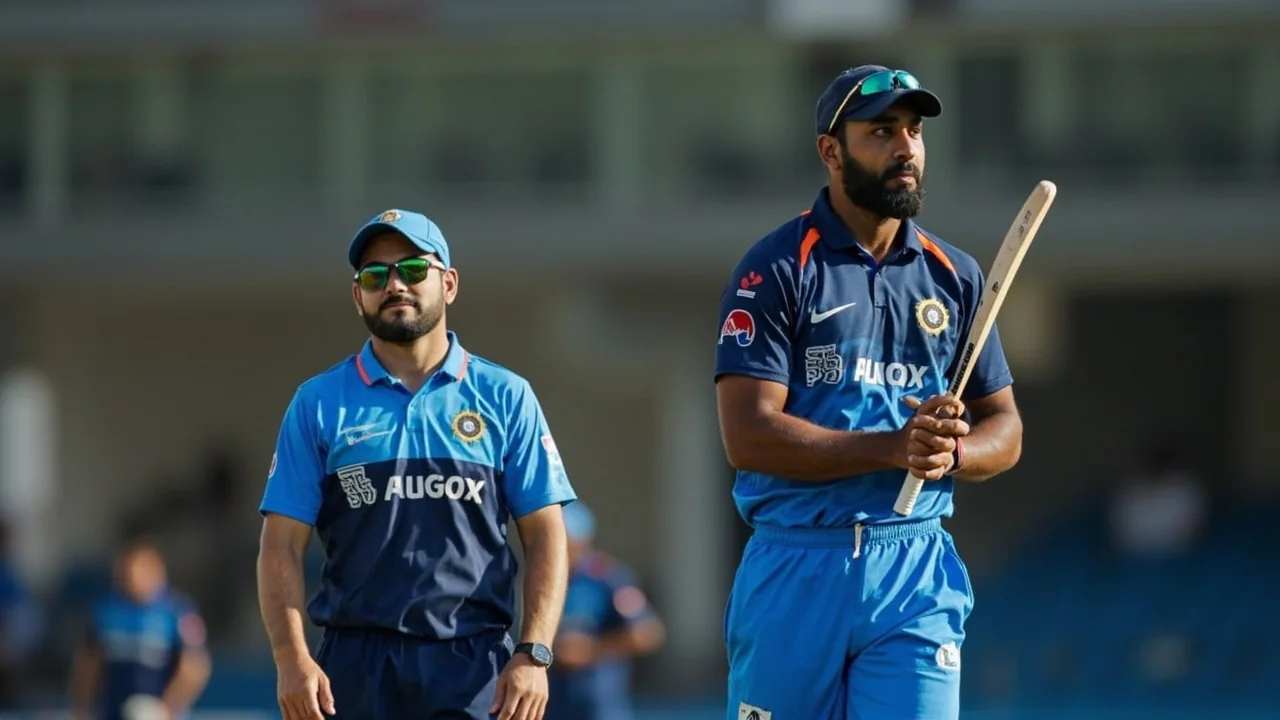
The Afghanistan Cricket Board has asked the BCCI to advance the upcoming three-match T20I series against India from the originally announced September 13, 15 and 17 to September 11, 13 and 14 at the Arun Jaitley Stadium in New Delhi. The proposal, reported by IANS and carried by Cricketnmore on 21 August 2026, lands two days earlier at the front of the series and two days earlier at the back. The shift is driven by the calendar: Ganesh Chaturthi falls on 14 September, the third-match date in the revised schedule, and a one-day gap between fixtures is what the ACB has put on the table.
The series context is unusual. Afghanistan is the official host nation for the bilateral series. The matches are being played in India because Afghanistan currently has no international-standard venue inside its own borders. The BCCI has framed the date question as Afghanistan's call to make, which means the operational changes, the broadcast windows and the fan-zone plans all sit with the ACB until a final answer is in writing. Nothing is locked in until both boards confirm.
What is verified in the date proposal
Five facts are confirmed in the 21 August 2026 IANS report. None of them is in dispute, and each one carries through to the fantasy build-up regardless of how the negotiations resolve.
The first fact is that the ACB has formally asked the BCCI to consider revised dates. The request is in writing and is the only reason the story exists. The proposal is on the table, not on the calendar.
The second fact is the shape of the proposal. The ACB has asked for September 11, 13 and 14, replacing the originally announced September 13, 15 and 17. The shift pulls the first T20I two days forward, tightens the middle gap from two nights to one, and lands the third T20I on the same day as Ganesh Chaturthi.
The third fact is the festival collision. Ganesh Chaturthi falls on 14 September 2026, and the third T20I in the revised schedule sits on that date. A match-day that overlaps with a major festival is a match-day where travel, gate attendance and broadcaster attention work differently from a normal midweek fixture.
The fourth fact is the host venue and the host status. Arun Jaitley Stadium in New Delhi is the venue for all three matches. Afghanistan is listed as the official host nation for the bilateral series. The arrangement reflects the reality that Afghanistan has no international-standard ground inside its own borders at this point in time.
The fifth fact is the framing from the BCCI. The BCCI has described the situation as Afghanistan's call because Afghanistan is the official host and because Afghanistan is the party that needs the dates to work for its players, its staff and its domestic calendar. The framing does not mean the BCCI is uninvolved. It means the calendar decision sits with the ACB until both boards sign.
What is still being negotiated
Three items sit between the ACB proposal and a final answer. Each one can move the schedule in either direction, and each one changes what a fantasy reader is planning for.
The first open item is the BCCI's response to the festival overlap. The 14 September slot is the most awkward part of the proposal. A sellable fixture on Ganesh Chaturthi depends on broadcaster confidence, on Delhi Police traffic planning around the festival processions, and on the franchise boards whose players are involved. The BCCI can accept the date, push for a one-day shift to 15 September, or revert to the original 17 September.
The second open item is the training and acclimatisation window. Pulling the first T20I two days forward shrinks the on-ground preparation from a comfortable four-day block to a tighter two-day block. Afghanistan's squad typically arrives five to six days before the first fixture for a T20I series. The advanced window either keeps that block intact and overlaps with the ACB's announced squad, or it cuts the block to three days. The training block is the part of a bilateral series that fantasy readers do not see but captain pools depend on.
The third open item is the squad announcement timing. Afghanistan usually names its T20I squad 10 to 14 days before the first fixture. If the revised September 11 opening holds, the squad announcement lands in the final week of August. If the schedule reverts, the squad announcement slides back. The squad announcement is the single biggest fantasy variable in any bilateral series, and the closer it sits to the first match, the less time a fantasy reader has to read the players desk notes.
How a tighter window changes the fantasy captain pool
The captain pool for a bilateral T20I series is built in three layers: the Afghanistan regulars who have held their slots across the last 12 months, the India regulars who cycle through the format, and the differentials who break into the XI when the conditions at Arun Jaitley favour a specific role. A tighter window changes how each layer is read.
The Afghanistan layer is the most exposed to a date shift. The squad travels from outside India, sits through quarantine and acclimatisation, and reads the venue for the first time in the training block. A two-day pull-forward reduces the recovery margin and increases the chance that a senior player is rested for the first match. The fantasy read is that the Afghanistan captaincy in the opener carries slightly more risk than usual, and the differentials in the Afghanistan middle order carry slightly more upside if the seniors sit out.
The India layer is the most insulated. India's T20I squad for a bilateral series at home is typically named inside the IPL calendar and the players come off a known domestic block. The advanced window does not change the squad but it does change the workload. A three-match series compressed into four nights means that the India captain and the death bowlers carry heavier recovery loads than a five-night series would. The fantasy read is that the India captain pick is still the safest anchor, but the vice-captain should be hedged toward a player who is likely to play all three matches.
The differential layer is the most moved. A shorter series rewards the bowlers who bowl at the death and the batters who bat at three or four, because those roles guarantee touches regardless of match situation. A shorter series punishes the players whose role depends on the match drifting into the second innings, such as a fifth-batter pinch-hitter or a third-spinner cameo. The fantasy read is that the differentials worth a slot are the players whose role does not change between T20Is.
| Fantasy layer | Effect of the advanced window | Captain call adjustment |
|---|---|---|
| Afghanistan regulars | Quicker turnaround, possible rest for the opener | Hedge the opener captaincy; favour the middle-order anchor |
| India regulars | Heavier workload across three matches in four nights | Captain pick stays with the India anchor; vice-captain shifts to a confirmed three-match player |
| Differentials | Roles are more stable when the series is shorter | Pick the death bowler and the number three or four as differentials |
What the venue read tells us ahead of confirmation
Arun Jaitley Stadium is a known surface for India home T20Is. The pitch has trended toward the chasing side in the last two white-ball cycles, with the average first-innings score at recent India T20Is sitting between 165 and 175 in the 20 overs. The square boundaries are short on the leg side and longer on the off side, which rewards batters who work the ball into the leg side and rewards bowlers who can bowl wide of off stump at the death.
The weather window for early-to-mid September in New Delhi is typically clear, with temperatures in the low 30s Celsius at the start of play and dew likely in the second innings. Dew is the variable that decides the toss call in nearly every India home T20I in this window. The chasing side has won the majority of day-night India T20Is at Arun Jaitley in the last 18 months.
The fantasy read on the venue is straightforward. The captain pick favours the chasing side's top order. The vice-captain pick favours the bowling side's powerplay bowler, who gets the new ball and the early swing. The differential worth a slot is the spinner who bowls in the middle overs on a dry surface, because the middle overs are where the captain pool narrows and where the differentials earn their multiplier.

What the original five-day series would have meant for fantasy
The originally announced September 13, 15 and 17 schedule gave fantasy readers a comfortable five-day window with a two-night gap between every match. That window is the format the captain pool is built around: a Tuesday opener, a Thursday middle match, and a Saturday closer, with one rest day each.
Five-day windows reward the captain pick on form because the recovery margin is wide enough for the in-form player to stay in the XI across all three matches. The differentials benefit too, because the wider gap lets a reader take a chance on a debutant or a returning player and rotate them out after one match without losing ground in the captain pool.
The fantasy read on the original window was a balanced one: captain on form, vice-captain on match-up, differentials on debut or return. The advanced window does not cancel that read. It compresses it. The captain pick stays anchored on form, but the vice-captain shifts to a confirmed three-match player and the differentials tighten to the roles that survive a shorter series.
What fantasy readers should do this week
Three moves sit at the front of the players desk this week. None of them require the final schedule to be confirmed.
The first move is to read the squad announcement carefully when it lands. The Afghanistan squad is the variable that moves the most in a date shift. Look for the players who are rested from the opener, the players who are recalled after injury, and the players who are named in the squad but expected to sit out the first match on rotation. The captain pool for the opener is built from those three lists.
The second move is to set the venue read once the schedule is confirmed. A confirmed Arun Jaitley pitch in September means a chasing-friendly surface with dew likely in the second innings. A shift to another venue would change the captain pool entirely. The venue read is the variable that locks in once the schedule is signed.
The third move is to plan the vice-captain around the confirmed three-match players. The advanced window rewards the players who play all three matches more than the players who play only one or two. A vice-captain pick on a confirmed three-match player is the hedge that survives a tighter schedule.
The three moves together give a fantasy reader a captain pool that survives the schedule, whichever way the ACB and BCCI resolve the negotiation. The pool does not depend on the final date. It depends on the squad, the venue and the role.
Limitations of this read
Two limits sit on this read. The first is that the ACB proposal is not yet a confirmed schedule. The BCCI has not signed the revised dates and the festival-overlap question is still open. A confirmed schedule could look like the original September 13, 15 and 17, like the ACB proposal of September 11, 13 and 14, or like a third option that splits the difference. The captain pool is built against the proposal, not against the final calendar.
The second limit is that no squad has been named for either side. Afghanistan typically announces its T20I squad 10 to 14 days before the first match, which means the squad announcement lands in the final week of August regardless of which schedule is confirmed. India typically announces its squad closer to the series, sometimes only five or six days before the opener. The fantasy captain pool depends on both announcements, and only the Afghanistan announcement is firmly in the window.
Both limits are honest ones. They do not change the venue read or the role read, and they do not change the captain pool's anchor on the chasing side's top order. They change only the timing of the final captain pick, which depends on the squad and the schedule both being confirmed.
What to watch next on the news desk
Three items sit at the top of the news desk for the next week. Each one is a small, verifiable fact that will move the captain pool.
The first item is the BCCI's formal response to the ACB proposal. The response is expected before the end of August and will either lock in the revised dates, revert to the original schedule, or propose a third option. The response will be carried on the BCCI's official site and on the verified BCCI social account.
The second item is the Afghanistan T20I squad announcement. The announcement typically names a 15- to 16-player squad with a captain and a vice-captain. The announcement will be carried on the Afghanistan Cricket Board site and on the ACB's verified social account.
The third item is the India T20I squad announcement. The announcement usually lands after the BCCI confirms the schedule and after the selection committee meets. The India squad will be carried on the BCCI site and on the verified India cricket social account.
The Fantoss news desk will continue to track each item against the verified source and will publish a confirmed-fixture brief once the schedule and the squads are signed. The fantasy captain pool is built one verified fact at a time, and the next three facts are the ones that decide the opener.
Frequently asked questions
What dates are the ACB proposing for the India Afghanistan T20Is?
The Afghanistan Cricket Board has asked the BCCI to advance the three T20Is to September 11, 13 and 14 at the Arun Jaitley Stadium in New Delhi, replacing the originally announced September 13, 15 and 17.
Why is Afghanistan proposing the date shift?
The proposed schedule lands the third T20I on Ganesh Chaturthi, 14 September 2026. The ACB's proposal tightens the build-up window and places the festival on the same day as the third match.
Where are the India Afghanistan T20Is being played?
All three matches are scheduled for the Arun Jaitley Stadium in New Delhi. Afghanistan is the official host nation for the bilateral series; the matches are being played in India because Afghanistan currently has no international-standard venue inside its own borders.
Who decides the final schedule?
The BCCI has framed the question as Afghanistan's call because Afghanistan is the official host. The ACB's proposal sits on the table until both boards confirm the revised schedule in writing.
When is the Afghanistan squad expected to be named?
Afghanistan typically names its T20I squad 10 to 14 days before the first match. If the revised September 11 opener holds, the squad announcement lands in the final week of August.
What does the date shift mean for a fantasy captain pick?
The tighter window rewards the captain pick on the chasing side's top order and rewards the vice-captain pick on a confirmed three-match player. The differentials worth a slot are the death bowlers and the middle-order batters whose role survives a shorter series.